How to Plan Restoration of a Torn or Scratched Photo Without Losing the Original
AnimaMoments ·
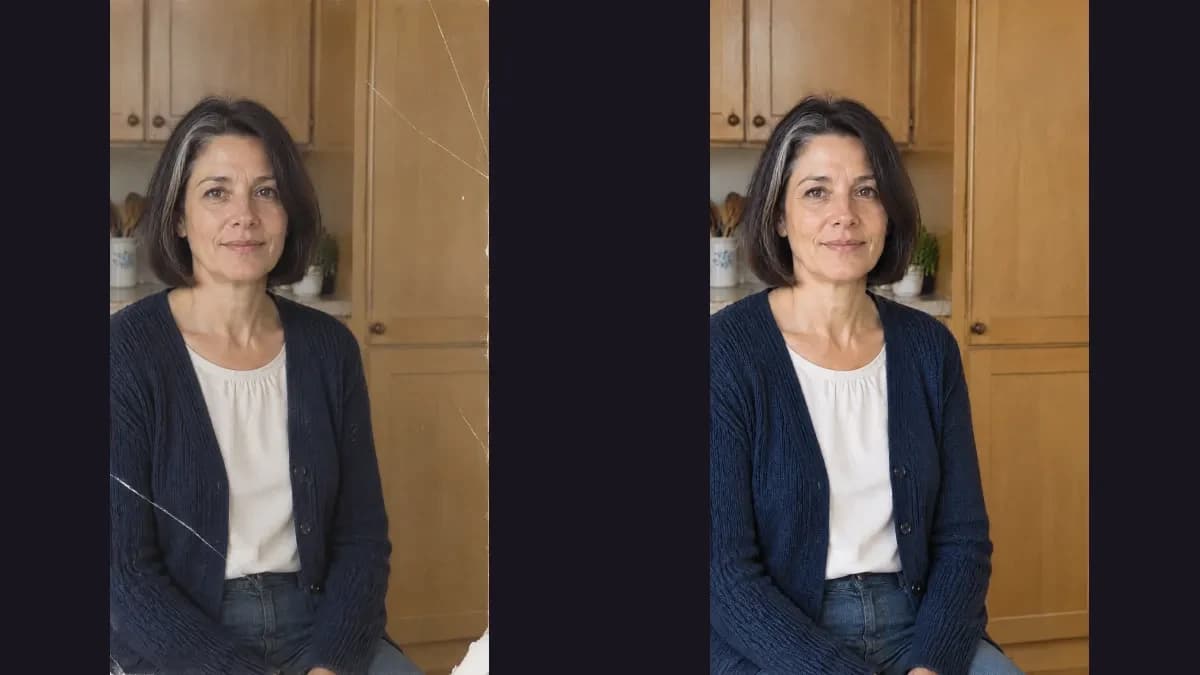
Before you restore a torn or scratched family photo, preserve the untouched digital master and make a separate working copy. Automatic restoration can reduce visible scratches, stains, and creases, but it cannot prove what was in a genuinely missing area. Use the damage map and scope card below to decide whether to proceed, find a better source, or defer the repair.
Start with two copies and a three-zone map
Keep the first scan or photograph exactly as captured. Give it a clear filename such as family-portrait-untouched-master.jpg, store a backup separately, and do not overwrite it with a restored version. Make a working copy named family-portrait-restoration-working.jpg for any automatic processing or later comparison.
Map each damaged area into one of three zones. Intact detail is visible information that should remain recognizable, such as a face, eye, garment edge, or background pattern. Surface damage is an obstruction over information that may still be partly visible, such as a scratch, stain, crease, or scanner mark. Missing information is an area where the source contains no original pixels, such as a torn-away corner or a blank gap. These zones require different expectations.
Filled damage map: one fictional color portrait
This worked example uses a newly created synthetic color portrait of a fictional 48-year-old woman with a dark chin-length bob, one narrow silver streak, a navy cardigan, and an ivory blouse in front of tan kitchen cupboards. Her face, eyes, nose, lips, and hairline are intact and clearly readable. That face is an anchor for comparison, not permission to invent new facial detail.
Surface damage: a pale diagonal crease crosses the lower-left cardigan below the face, and thin scratches run across the upper-right cupboard background. Visible source detail: the cardigan color, blouse edge, cupboard grain, and the surrounding colors remain partly readable beneath or beside the marks. Missing information: a small irregular blank corner at the extreme lower-right background contains no original image detail. Any fill there may make the frame look complete, but it is invented rather than recovered.
Write the repair scope before restoring
Copy this card for each photograph: Untouched master filename — [exact original file]. Working-copy filename — [separate copy]. Damaged region — [location and size]. Visible source detail — [what remains readable]. Surface damage — [scratch, crease, stain, tear, or scanner mark]. Missing information — [area with no original pixels, or none]. Acceptable purpose — [private viewing, family reference, or clearly labeled interpretation]. Decision — [proceed, find a better source, or defer]. Boundary — [what must remain unchanged and what invented fill must never be treated as fact].
Filled card: Untouched master — family-portrait-untouched.jpg. Working copy — family-portrait-restoration-working.jpg. Damaged region — lower-left cardigan crease, upper-right cupboard scratches, and lower-right background corner. Visible source detail — intact face, navy cardigan, ivory blouse, tan cupboards, and readable surrounding textures. Surface damage — crease and scratches. Missing information — small background corner only. Acceptable purpose — a more legible, clearly labeled family-photo interpretation. Decision — proceed cautiously. Boundary — preserve the same adult, pose, clothing, framing, and setting; do not treat the corner fill as historical evidence.
Use the decision path after mapping
Proceed with a bounded digital restoration when the important subject remains intact and the damage is mainly surface-level. Compare the working copy with the untouched master and reject any result that changes the recognizable adult, pose, clothing, framing, or setting beyond your written scope.
Find a better source when glare, blur, a poor scan, compression, or severe shadow hides information that may still exist on the physical print or another scan. A cleaner capture can provide genuine source detail; automatic processing cannot manufacture evidence from an unreadable capture.
Defer the repair when an identity-critical feature is genuinely absent, especially an eye, mouth, major facial area, or distinctive marking. Do not describe a generated reconstruction as the person’s recovered face. A missing background corner may be acceptable as an invented fill when clearly labeled, but missing identity information calls for another source or a decision to leave the area unresolved.
What Restore can and cannot do
After the preservation plan is complete, AnimaMoments’ Photo Restore style lets you select the style and upload the photograph for automatic preparation. It is suited to this example because the face is intact and the visible damage is concentrated on the print surface and background. The style requests conservative restoration while retaining the same person, pose, clothing, framing, and setting; those are requests, not guarantees.
The example produces one prepared still from a synthetic, already-color aged portrait. It does not use a manual mask, brush, free-form instruction, or selective repair control. It does not repair the physical print, recover historical truth, or demonstrate an animation. Keep the untouched master beside the prepared result, and label any filled missing area as generated interpretation. Old monochrome or sepia sources may also receive plausible generated color during preparation; this already-color example does not test that behavior.
Illustrative example
A bounded restoration decision in practice
The example begins with one newly created synthetic color portrait of a fictional adult woman, age 48, with a dark bob and silver streak, navy cardigan, and ivory blouse against tan kitchen cupboards. Her face is intact. A pale crease crosses the lower cardigan, scratches mark the cupboard background, and a small blank corner removes only background detail. Restore uses its fixed automatic preparation for one conservative repair attempt. It requests the same person, pose, clothing, framing, and setting; these are not guaranteed or selectively enforceable. Any generated missing-corner fill remains invented.
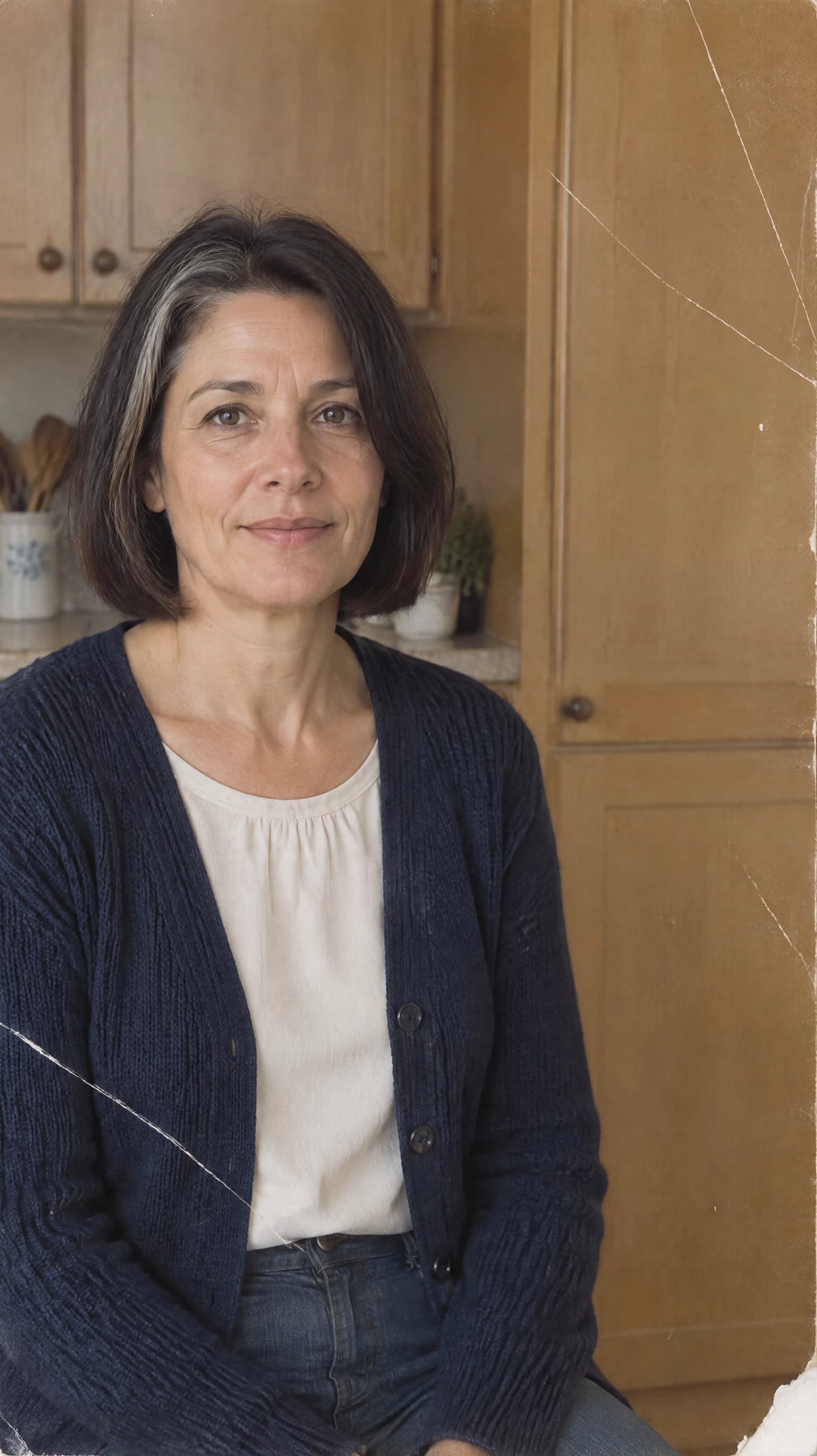
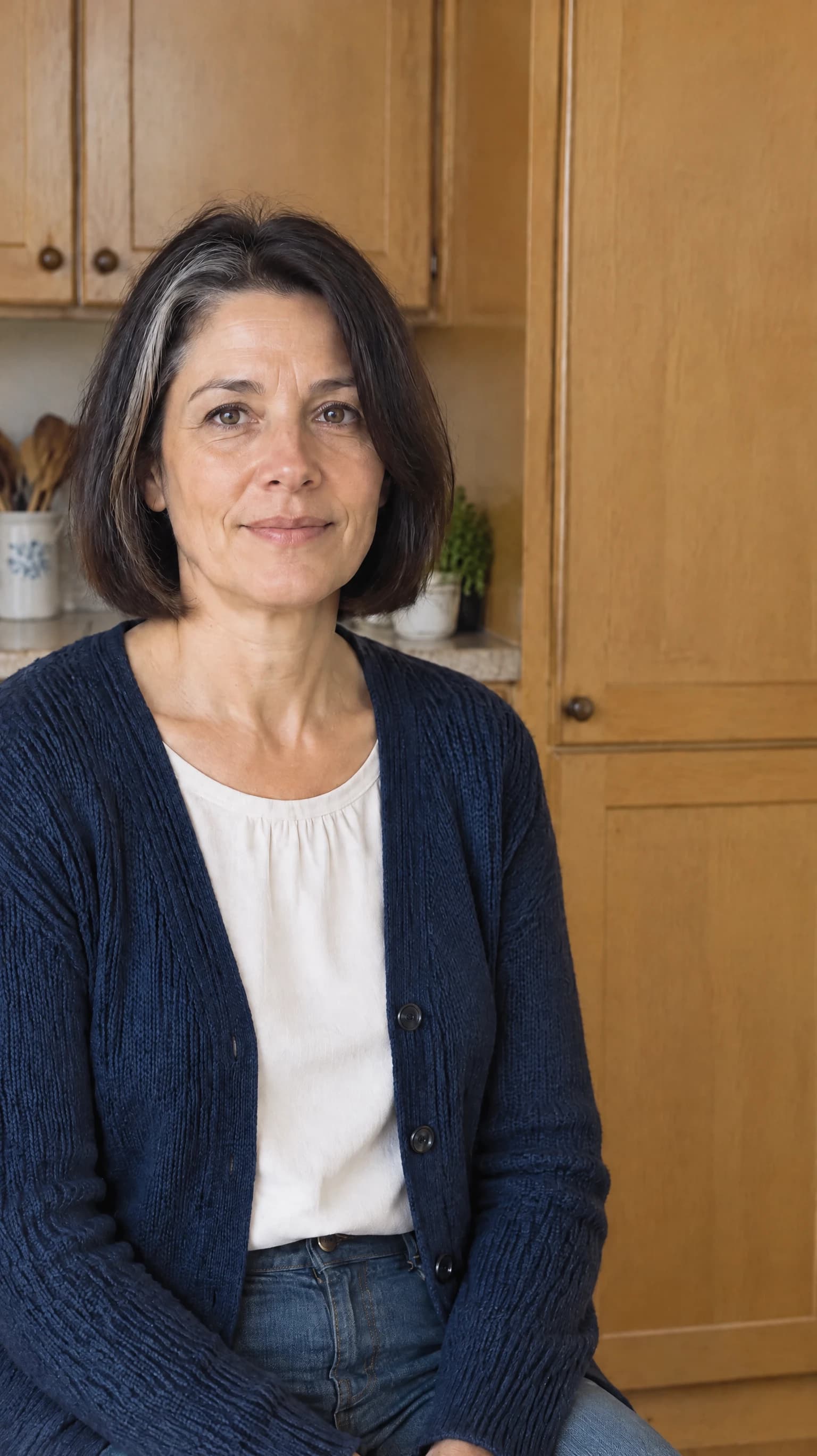
A synthetic aged color portrait of one fictional 48-year-old adult woman with a straight dark chin-length bob and one narrow silver streak near her left temple. She has readable brown eyes, natural facial lines, and a relaxed closed-mouth expression. She wears a navy knitted cardigan over an ivory blouse and sits upright before tan wooden kitchen cupboards in soft diffuse daylight. Her complete head, shoulders, and torso to the waist are visible. The face is intact. A pale diagonal crease crosses the lower cardigan, thin scratches affect the upper-right cupboard background, and a small blank missing corner appears only at the extreme lower-right background. This is a fictional illustration, not a family archive or historical photograph.
All example media use synthetic inputs and depict the fictional adult, object, or setting described in this example. This is an illustrative example, not a customer result; outcomes vary.
FAQ
Should I replace the only original with the restored output?
No. Keep the untouched master unchanged and restore only a separately named working copy. Retain both files so you can compare the result with the original source and return to the first scan if the repair introduces unwanted changes.
Can this worksheet selectively mask or restrict automatic changes?
No. The worksheet defines your preservation boundary and helps you judge the result, but it is not an app mask or enforceable selective command. Use it to identify acceptable surface repair, protected details, and areas where generated fill must remain clearly labeled.
What if the face itself is torn or missing?
Look for another scan, a duplicate print, a related photograph, or another trustworthy source before attempting restoration. If an identity-critical feature is genuinely absent, defer or label any reconstruction as an invented interpretation rather than claiming that automatic restoration recovered the original.